

In the late 1800s, the basement of what is now the Pilot Point Community Opera House was home to a bustling freight delivery system. Horse-drawn wagons entered through a large stone archway, deposited their goods on an elevator bound for the R.T. Evans & Co. Hardware store upstairs, then exited through another arched doorway.
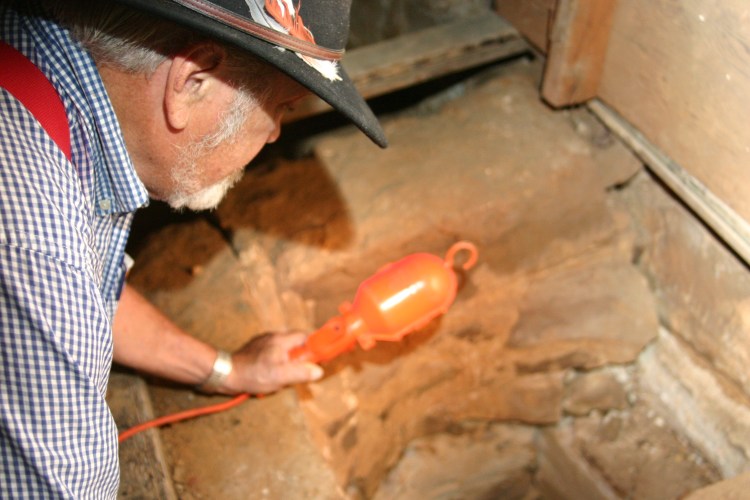
Tucked along the wall was a water well that provided respite from the Texas heat for the horses carrying cargo to and from the historic Pilot Point Square.
The basement of the Opera House has changed somewhat since then. The elevator was boarded up, extra support beams were installed, and the basement’s exit door was walled shut and buried under a car ramp.
The stone-lined walls of that hundred-year-old well, however, still remain in the basement of the Opera House.
“The well was a water supply,” said Howard Kimble, president of the Opera House Board. “I think the well was put in before or at the time the Opera House was built, just looking at the structure and how it fits in to the wall.”
That puts the date of the well at around 1884, when R.T. Evans opened a hardware store on the first story of what is now the Opera House. The building’s now defunct second story was added later in 1894 to accommodate performance space for the growing town of Pilot Point.
The well itself is small, narrow and unassuming. Covered with a board, the dimly lit hole plunges down 20 feet into the soil and water still collects at the bottom.
Unfortunately a few other things have collected at the bottom over the years. Pieces of trash and debris currently sully the waters below the Opera House, and Kimble’s next mission is to find a way to clean it up.
“The current thing is addressing the well,” Kimble said. “We get it cleaned out, we’ll have it tested and see what we’ve got.”
First they’ll need to pump more water out of the well, Kimble said. After that they’ll rely on a volunteer who, harnessed up in mountain climbing gear, will descend downwards until she can reach the debris currently hidden in the dark waters.
That volunteer is an experienced mountain climber who is “used to scaling rocks,” Kimble said.
“She’ll have a harness and we’ll hook a rope to a beam up there,” he said. “There’ll be some people around to let her down in.”
After the water is cleaned Kimble will have it tested. In an area where cities like Mineral Wells and Tioga were built around therapeutic mineral water, a well with fresh spring water could be a valuable thing. Kimble recalls an instance from several years ago where the well water’s possible healing properties came to light.
Spurred on by the promise of a $100 donation to the Opera House, Kimble drew up a fresh cup of water from the well and drank it. A woman standing by to witness declared that she would also drink a cup and, over the next four to five weeks, her gray hair began to darken.
“I made that part up,” laughed Kimble.
Fountain of Youth or not, the well water below the Opera House paints a picture of what mercantile life was like in the earliest days of Pilot Point.
This article originally appeared in the Pilot Point Post-Signal.
 Heather Michelle Tipton